Unlocking Realism: How 30 Rubble Stone Texture Backgrounds Transform Your Design Projects
When it comes to creating stunning design projects, the smallest details often make the biggest impact. You can have the most innovative layout or the most sophisticated 3D model, but if the surface materials look flat or artificial, the entire illusion breaks. One such detail that significantly enhances the overall look and feel of your work is the use of high-quality textures and backgrounds. Specifically, integrating a robust collection like the 30 Rubble Stone Texture Backgrounds set can elevate your output from "good" to "unforgettable." This isn't just about slapping an image onto a surface; it's about bringing the grit, history, and tangible weight of real stone into your digital creations.
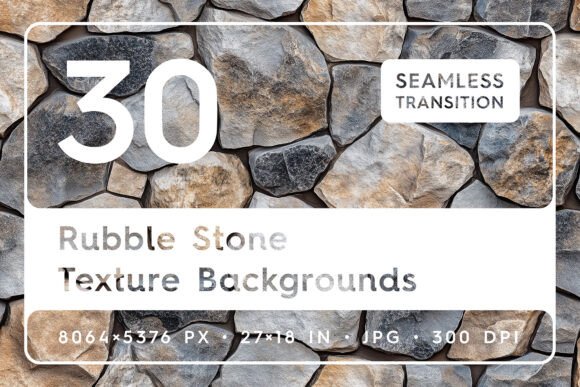
The 30 Rubble Stone Texture Backgrounds package offers a curated selection of high-resolution imagery designed to mimic the chaotic yet beautiful nature of rubble stone masonry. Unlike generic stock photos that often suffer from repetitive patterns or low resolution, this set provides large file sizes with seamless joints. Each image boasts a dimension of 8064 × 5376 pixels at a crisp 300 DPI, ensuring that whether you are printing a massive billboard or zooming in on a close-up render, the texture remains sharp and authentic. The seamless transition capability is particularly crucial for 3D artists, as it allows for infinite tiling without visible seams that would otherwise ruin the immersion of a virtual environment.
Bringing Architectural Visualizations to Life
For architectural visualizers and interior designers, the struggle to find believable exterior cladding is real. Rubble stone is a staple in rustic cottages, historic renovations, and luxury landscape designs, yet capturing its irregularity in a render is notoriously difficult. This is where the versatility of the 30 Rubble Stone Texture Backgrounds shines. Imagine you are working on a project for a client who wants to visualize a modern farmhouse with a traditional stone foundation. Using these textures, you can map the stones onto your 3D geometry, knowing that the variation in color and shape will prevent that dreaded "stamped" look.
In exterior contexts, these backgrounds serve as more than just wall coverings. They are essential for creating realistic environmental backdrops. When placing a 3D model of a new structure into an existing scene, the background needs to match the lighting and texture of the surroundings. The high resolution ensures that when sunlight hits the virtual stones, the micro-displacement and color variance react naturally, adding depth and shadow that flat colors simply cannot achieve. For interior applications, perhaps a feature wall in a lobby or a fireplace surround, these textures provide the tactile quality that helps clients emotionally connect with the space before a single brick is laid.
Elevating Printed Advertising and Branding
Beyond the digital screen, the utility of these textures extends powerfully into the realm of printed advertising. In an era where digital fatigue is real, print media that offers a sensory experience stands out. Consider a brochure for a heritage brand, a wine label for a vineyard with stone cellars, or a luxury real estate flyer. Incorporating elements of the 30 Rubble Stone Texture Backgrounds can convey stability, longevity, and earthiness. Because the files are provided in JPG format at 300 DPI, they are print-ready straight out of the box, eliminating the need for time-consuming upscaling that often degrades image quality.
Graphic designers often face the challenge of creating backgrounds that are interesting but not distracting. The organic nature of rubble stone provides a perfect middle ground. It adds visual interest and texture without overwhelming the foreground text or product photography. For instance, a cosmetic brand aiming for a "natural" and "organic" aesthetic might use a softened version of these stone textures as a backdrop for their packaging design, subtly communicating purity and connection to the earth. The sheer quantity of 30 unique images means you can maintain consistency across a campaign while avoiding repetition, keeping the viewer engaged throughout the piece.
A Resource for Game Developers and VFX Artists
The gaming industry and visual effects sector demand assets that can withstand close scrutiny. Players and viewers today are incredibly discerning; they can spot a low-res texture from a mile away. The 30 Rubble Stone Texture Backgrounds set is an invaluable resource for environment artists building medieval towns, post-apocalyptic ruins, or fantasy dungeons. The seamless nature of the joints allows for the creation of vast walls and sprawling landscapes without worrying about visible tiling artifacts breaking the player's immersion.
Furthermore, the high pixel count (over 8000 pixels wide) allows VFX artists to extract specific details or create custom normal maps and displacement maps with incredible fidelity. Whether you are texturing a crumbling castle wall in a cinematic cutscene or designing the environment for an open-world RPG, having a diverse library of stone variations prevents the environment from feeling sterile. The differences in weathering, moss growth, and stone coloration found within the 30-image set allow for storytelling through the environment itself, hinting at the age and history of the structures within your world.
Practical Considerations Before You Start
While the benefits are clear, there are practical considerations to keep in mind when integrating these assets into your workflow. First, consider the file size. With dimensions of 8064 × 5376 px, these are substantial files. While this guarantees quality, it also means they require more RAM and processing power when loaded into software like Blender, Maya, Photoshop, or Unreal Engine. It is advisable to ensure your workstation is optimized for handling high-resolution assets to prevent lag during the design process.
Secondly, think about lighting. High-quality textures reveal their true potential only when lit correctly. A flat, uniform light source will flatten even the best rubble stone texture. To get the most out of the 30 Rubble Stone Texture Backgrounds, experiment with angled lighting to cast shadows in the crevices between the stones, highlighting the depth and irregularity that makes rubble stone so visually appealing. Additionally, while the seamless feature is a massive advantage, always check the scale. What looks like a small cobblestone on a full-screen background might look like a boulder if mapped onto a small object without adjusting the UV scaling.
Why This Collection Stands Out
What truly sets this collection apart is the balance between variety and cohesion. Many texture packs suffer from having images that look like they were taken in completely different locations with incompatible lighting conditions. However, this set maintains a consistent aesthetic while offering enough variation to suit different moods—from dry, sun-baked stones to cooler, damp-looking masonry. This coherence allows designers to mix and match textures within a single project without the result looking disjointed.
Ultimately, the goal of any designer is to tell a story and evoke a feeling. Materials play a huge role in that narrative. By utilizing the 30 Rubble Stone Texture Backgrounds, you are not just filling space; you are adding character, history, and realism to your work. Whether you are an architect pitching a new development, a graphic designer crafting a memorable brand identity, or a game artist building a new world, these textures provide the foundational realism needed to make your vision credible. In a competitive market, those small details—the grain of the stone, the subtle shift in color, the seamless flow of the pattern—are often what separate a professional masterpiece from an amateur attempt.